
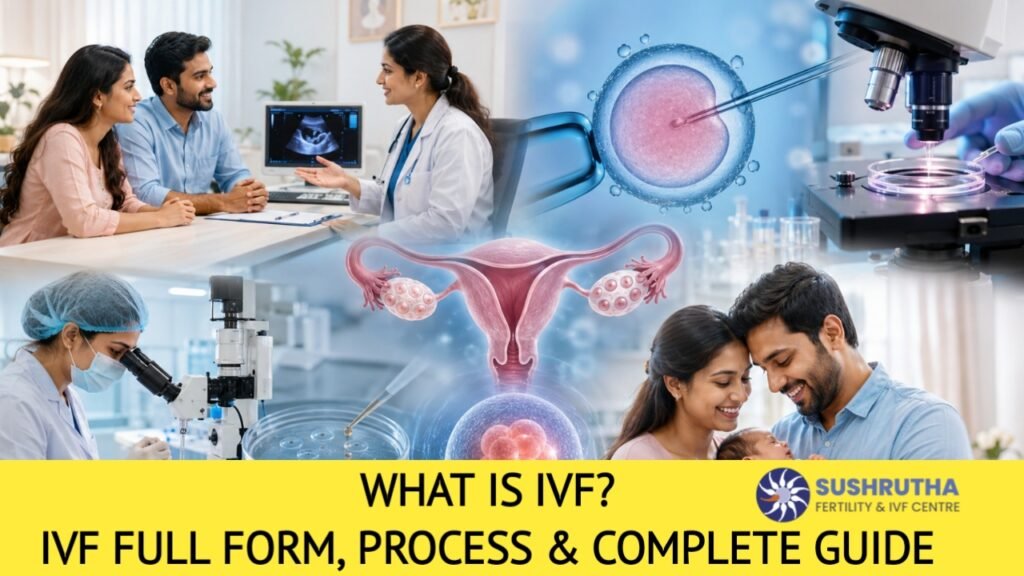
What is IVF? IVF Full Form, Process & Complete Guide Many couples today struggle to conceive naturally. Medical science has given us a revolutionary solution — IVF (In Vitro Fertilization). Every year, lakhs of couples across India are turning their dream of parenthood into reality with the help of IVF treatment.
| 10M+ | 4-6 wks | 40-50% | 1978 |
| IVF Babies Worldwide | Per IVF Cycle | Success Rate (Under 35) | Year IVF Introduced |
What is the Full Form of IVF?
The full form of IVF is — In Vitro Fertilization. IVF is also commonly called “Test Tube Baby” treatment.
| I | V | F |
| In | Vitro | Fertilization |
| (Latin: “inside glass” – outside the body) |
| 📌 Did You Know? The world’s first IVF baby, Louise Brown, was born in England on July 25, 1978. Since then, over 10 million babies have been born worldwide through IVF technology. |
What is IVF?
In a normal pregnancy, a woman’s egg and a man’s sperm meet inside the fallopian tube to form an embryo. But when this cannot happen naturally inside the body, IVF performs this process outside the body — in a specialized laboratory.
“IVF is a process where a woman’s egg and a man’s sperm are fertilized in a lab, and the resulting embryo is placed into the woman’s uterus.”
Once the embryo is transferred, the pregnancy progresses exactly like a normal pregnancy — there is no difference.
Who Needs IVF Treatment? What is IVF?
- Blocked or damaged fallopian tubes — egg and sperm cannot meet naturally
- Male infertility — low sperm count or poor sperm quality
- Endometriosis — tissue growing outside the uterus
- PCOS or irregular ovulation — eggs not releasing at the right time
- Unexplained infertility — when no clear cause is found
- Age-related infertility — difficulty conceiving naturally after age 35
- Recurrent miscarriage — repeated pregnancy loss
- Genetic disease prevention — using PGT-A testing
- Failed IUI cycles — after 3 or more unsuccessful IUI attempts
| 💡 Know This: If you have been trying to conceive for 1 year (under 35) or 6 months (over 35) without success — consult a fertility specialist today. |
What is the IVF Process? – 6 Main Steps
| 01 Ovarian Stimulation Hormone injections over 8-14 days stimulate the ovaries to produce multiple eggs. Regular ultrasounds and blood tests monitor egg development. | 02 Egg Retrieval Minor surgical procedure – eggs collected using a thin needle under mild sedation. Takes just 20-30 minutes. Patient goes home the same day. |
| 03 Sperm Collection & Fertilization Semen sample collected same day. Eggs and sperm combined in the lab. ICSI used if needed – single sperm injected directly into the egg. | 04 Embryo Development Fertilized eggs kept in a special incubator for 3-5 days, developing into embryos. Best quality embryos selected for transfer. |
| 05 Embryo Transfer Selected embryo inserted into the woman’s uterus through a thin catheter. Completely painless – takes only 5-15 minutes. Two-week wait follows. | 06 Pregnancy Test Beta-hCG blood test done 14 days after embryo transfer to confirm pregnancy. If positive – your IVF journey was successful! |
What is IVF IVF Timeline:
| Injections Start | > | Egg Retrieval | > | Embryo Transfer | > | Pregnancy Test |
Total Duration: Approximately 4 to 6 weeks per cycle
IVF Success Rate – Age-Wise
| Woman’s Age | Success Rate (Per Cycle) | Recommendation |
| Below 35 years | 40-50% | Best time for IVF |
| 35-37 years | 35-42% | Good results expected |
| 38-40 years | 25-35% | Seek expert guidance |
| 40-42 years | 15-22% | Consider donor egg options |
| Above 42 years | 5-10% | Donor egg strongly advised |
| Remember: One unsuccessful IVF cycle does not mean failure. Many couples succeed in their 2nd or 3rd cycle. Every cycle helps your doctor refine a better treatment plan for you. |
Risks of IVF – What to Know
| Risk | Description | How Common? |
| OHSS | Ovarian overstimulation | 1-5% |
| Multiple Pregnancy | Twin/triplet births | 20-30% |
| Ectopic Pregnancy | Embryo implants outside uterus | 2-5% |
| Miscarriage | Same risk as natural pregnancy | 15-20% |
| Infection | During egg retrieval | Less than 1% |
What is IVF (FAQs)
Q1. Is IVF painful?
Most women experience mild discomfort during injections and egg retrieval. The embryo transfer itself is completely painless.
Q2. How many IVF cycles are needed?
Some couples succeed in the first cycle. Others may need 2-3 cycles. Your doctor will guide you based on your individual case.
Q3. Is the IVF baby normal and healthy?
Yes. IVF babies are as healthy and normal as naturally conceived babies. There is no medical difference.
Q4. What is the cost of IVF in India?
IVF costs in India typically range from Rs. 1.5 lakh to Rs. 2.5 lakh per cycle, depending on the city and clinic. Always confirm all costs upfront.
Q5. Can IVF be done after age 40?
Yes, IVF is possible after 40, though success rates are lower. Donor egg IVF is often recommended for better outcomes.
Q6. What is the difference between IVF and IUI?
IUI places sperm directly into the uterus. IVF fertilizes the egg outside the body in a lab – a more advanced procedure suited for complex infertility cases.
Conclusion
Now you have complete information — what is IVF, the IVF full form, and the entire IVF process step by step. IVF is a modern, safe, and highly effective option for couples who cannot conceive naturally. The right doctor, the right timing, and a healthy lifestyle significantly improve your IVF success chances.
If you have been struggling to conceive, consulting an experienced fertility specialist is always the best first step. Free consultations are a great way to start — no pressure, just honest guidance.