
Can You Get Pregnant with an Ovarian Cyst? What You Need to Know Discovering you have an ovarian cyst can feel alarming, especially when you are trying to conceive. The good news is that most ovarian cysts do not prevent pregnancy. However, the type of cyst, its size, and any underlying condition all play a role in how it may affect your fertility and your pregnancy journey.
What Is an Can You Get Pregnant with an Ovarian Cyst? What You Need to Know?
An ovarian cyst is a fluid-filled sac that forms on or inside an ovary. They are extremely common and affect women of all ages. Most cysts are benign (non-cancerous) and resolve on their own within a few menstrual cycles without treatment.
Types of Can You Get Pregnant Ovarian Cysts
an You Get Pregnant with an Ovarian Cyst Understanding the type of cyst you have is the first step in assessing how it might affect conception:
Functional cysts — the most common type, including follicular cysts and corpus luteum cysts. These develop as part of the normal menstrual cycle and usually disappear within 2–3 months.
Endometriomas — also called ‘chocolate cysts,’ these form due to endometriosis and can significantly impact egg quality and ovarian reserve.
Polycystic ovaries (PCOS) — a hormonal condition where multiple small cysts develop and ovulation becomes irregular or absent.
Dermoid cysts and cystadenomas — these are less common and typically benign, but may require surgical removal if they grow large.
Is Pregnancy Possible with an Ovarian Cyst?
Yes — pregnancy is absolutely possible with an ovarian cyst. In fact, many women conceive naturally without ever knowing they had a cyst. Functional cysts, in particular, rarely interfere with ovulation or fertilisation.
| Key fact: The majority of ovarian cysts are harmless and do not affect a woman’s ability to conceive. Only certain types, such as endometriomas or cysts associated with PCOS, are more likely to impact fertility. |
When a Cyst May Affect Fertility
Some conditions that cause cysts can reduce fertility by disrupting ovulation, damaging ovarian tissue, or blocking the fallopian tubes. These include:
Endometriosis, which can cause scarring and impair egg release. PCOS, which leads to irregular or absent ovulation. Large cysts that physically block the ovary or fallopian tube. Surgical removal of large cysts, which in rare cases may reduce ovarian reserve.
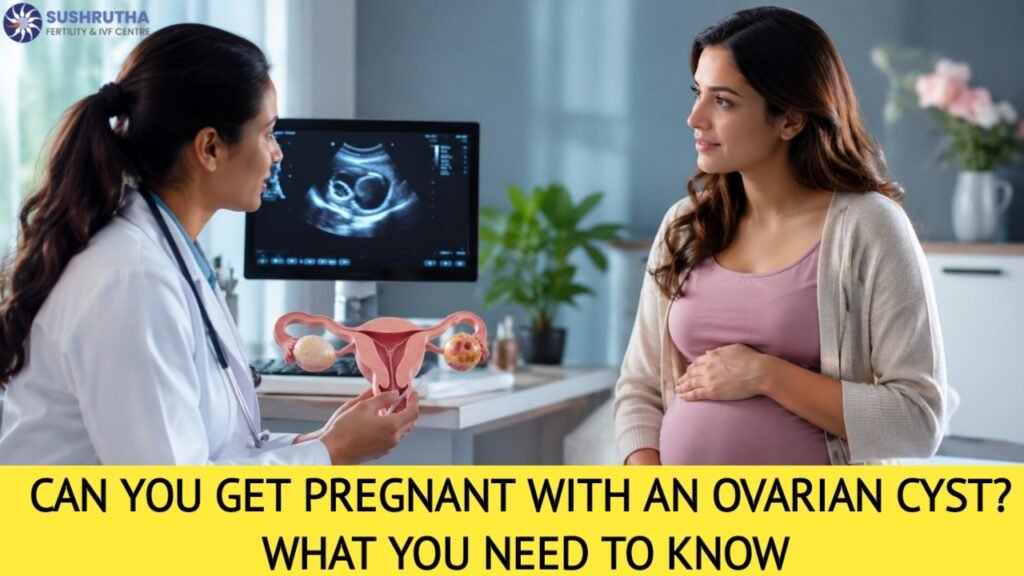
Ovarian Cysts During Pregnancy
It is also possible to develop an ovarian cyst after you become pregnant. Many of these are corpus luteum cysts, which form to support the pregnancy during the early weeks and typically resolve by the second trimester.
Are Cysts During Pregnancy Dangerous?
Can You Get Pregnant with an Ovarian Cyst? What You Need to Know Most cysts found during pregnancy are benign and do not pose a risk to the mother or baby. However, there are a few complications to be aware of:
Cyst rupture — a large cyst can rupture, causing sudden, severe abdominal pain that may require emergency treatment.
Ovarian torsion — the weight of a growing cyst can cause the ovary to twist, cutting off its blood supply. This is a medical emergency requiring immediate surgery.
Obstruction during labour — in rare cases, a large cyst near the cervix could complicate delivery, possibly requiring a caesarean section.
How Are Cysts Monitored in Pregnancy?
If a cyst is detected during a routine ultrasound in early pregnancy, your doctor will typically monitor it with follow-up scans. Small, simple cysts (under 5 cm) are usually watched closely. Larger or complex cysts may warrant additional investigation or surgical intervention, ideally during the second trimester when risks are lower.
Treatment Options for Ovarian Cysts When Trying to Conceive
If you are planning a pregnancy and have been diagnosed with an ovarian cyst, your treatment will depend on the cyst type, size, and whether it is causing symptoms.
Watchful Waiting
For functional cysts, doctors often recommend a ‘watch and wait’ approach. These cysts commonly resolve within one to three menstrual cycles without any intervention.
Medication
Hormonal treatments such as oral contraceptives are sometimes used to prevent new cysts from forming, though they are not typically recommended for women actively trying to conceive.
Surgery
Surgical removal (cystectomy) may be recommended for large, persistent, or complex cysts. Laparoscopic surgery is the preferred approach as it is minimally invasive. It is important to discuss ovarian reserve with your surgeon before the procedure, especially if you are planning to become pregnant.
PCOS and Pregnancy: A Special Consideration
Polycystic Ovary Syndrome (PCOS) is one of the leading causes of female infertility. Women with PCOS have elevated levels of androgens (male hormones) and often do not ovulate regularly, making conception more difficult.
However, with the right support, many women with PCOS do achieve successful pregnancies. Treatments include lifestyle changes (particularly weight management), ovulation induction medications such as letrozole or clomiphene, and in some cases, assisted reproductive technologies (ART) like IVF.
When to See a Doctor
You should consult your gynaecologist or fertility specialist if you are trying to conceive and have been diagnosed with an ovarian cyst, or if you experience any of the following symptoms:
Pelvic pain or pressure, bloating or a feeling of fullness, pain during intercourse, irregular or painful periods, or sudden severe abdominal pain (which requires emergency attention).
| Important: Never ignore sudden, severe pelvic pain. It may indicate a ruptured cyst or ovarian torsion — both of which require prompt medical treatment. |
Can You Get Pregnant with an Ovarian Cyst? What You Need to Know (FAQ)
Can a cyst on one ovary affect pregnancy chances?
Not necessarily. If the other ovary is healthy and ovulating normally, conception is still very possible. One functioning ovary is generally sufficient for natural pregnancy.
Will a cyst cause a miscarriage?
Simple, functional cysts are not known to increase the risk of miscarriage. However, complex conditions like endometriosis or PCOS may be associated with slightly higher miscarriage rates, which is why early monitoring and specialist care are important.
Can you feel an ovarian cyst during pregnancy?
Small cysts typically cause no symptoms. Larger cysts may cause a dull ache or pressure in the lower abdomen. Many cysts are discovered incidentally during routine pregnancy ultrasounds.
Can You Get Pregnant with an Ovarian Cyst? What You Need to Know Conclusion
In most cases, having an ovarian cyst does not mean you cannot get pregnant. The majority of cysts are benign, self-resolving, and have little to no impact on fertility. That said, certain types of cysts — particularly those linked to endometriosis or PCOS — may require medical management before or during pregnancy. If you have been diagnosed with an ovarian cyst and are trying to conceive, speak openly with your doctor. With the right monitoring and treatment, most women with ovarian cysts go on to have healthy pregnancies.