
IVF Treatment Explained: A Step-Step Guide
Explore the intricate steps of IVF treatment in our detailed guide. Learn how in vitro fertilization offers hope for starting a family when the natural conception isn’t viable.
Understanding the IVF Treatment Process
Infertility Treatment: Understanding the Process
It can be exciting and daunting to embark on the journey of in vitro fertilization (IVF). In cases where natural conception isn’t possible, IVF offers hope of starting a family. What exactly is the IVF process? Here, we’ll explain how IVF treatment works, so you know what to expect.
What is IVF Treatment?
In vitro fertilization (IVF) is a type of assisted reproductive technology (ART). IVF involves retrieving eggs from the ovaries of a woman and fertilizing them with sperm in a laboratory. Embryos are monitored for growth and development once fertilized. Embryos are then transferred to a woman’s uterus with the hope of achieving a successful pregnancy.
Process of IVF Treatment
IVF consists of several key stages. An increased chance of pregnancy depends on each stage.
1. Initial Consultation and Testing
IVF begins with a consultation with a fertility specialist. In this initial consultation, the doctor will review your medical history, discuss previous fertility treatments, and order fertility tests. Hormone levels can be checked through blood tests, ovaries and uterus can be assessed through ultrasounds, and male partners can have their semen tested.
2. Ovarian stimulation.
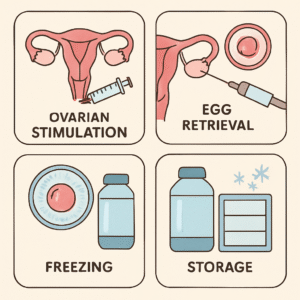
After testing is complete, ovarian stimulation follows. Multiple eggs are produced during this phase by stimulating the ovaries. Fertility medications can assist the ovaries in producing more eggs at once than they normally do during each menstrual cycle. Injections are usually given over a period of 8 to 14 days.
Blood tests and ultrasounds will be conducted during this time to monitor your progress and adjust medication dosages as needed. Monitoring ensures eggs
3. Egg retrieval
An egg retrieval procedure is performed when the eggs are ready. Usually, this procedure takes between 20 and 30 minutes and is done under sedation. An ultrasound guide is used to insert a thin needle into the vaginal wall in order to collect eggs from the ovaries. Most patients recover quickly from retrieval after mild cramps or spotting.
4. Fertilization and embryo culture
In the lab, retrieved eggs are combined with sperm from a partner or donor. A single sperm can be injected directly into an egg during intracytoplasmic sperm injection (ICSI), or conventional insemination, which involves mixing sperm with eggs.
After fertilization, embryos are cultured in a controlled environment for several days. In this period, embryologists monitor their development to select the healthiest embryos for transfer.
5. Embryo Transfer
IVF continues with embryo transfer. A transfer can occur between two and five days after fertilization, depending on your specific circumstances. An embryo is placed into the uterus using a thin catheter. In most cases, there is no pain involved and no sedation is required.
Prior to resuming normal activities after the transfer, you may be advised to rest. Any lifestyle changes or medications needed to support implantation and early pregnancy should be followed according to your doctor’s instructions.
6. The Two-Week Wait
A pregnancy test can be performed about two weeks after embryo transfer. It can be emotionally challenging to wait for the results during this time. During this time, taking care of yourself, both physically and emotionally, is crucial.
7. Pregnancy Test and Follow-up
After two weeks, a blood test is performed to check for pregnancy. The clinic will schedule follow-up appointments if the test is positive. In the event that the test is negative, your doctor will discuss the next steps and any additional treatment options with you.
Factors Influencing IVF Treatment Success
IVF treatment can be successful or unsuccessful based on several factors, such as age, the cause of infertility, and embryo quality. Having realistic expectations and understanding that it may take multiple cycles to conceive is important when considering IVF.
Summary
IVF is a not complicated process that requires patience and resilience. By understanding each step, you can ease anxiety and be prepared for what lies ahead. Knowing what to expect can empower you to make informed decisions and provide a sense of control over your fertility journey, whether you’re just starting the process or already involved. Consult a fertility specialist if you’re considering IVF to discuss your unique situation and determine the best course of action.